Enterprise Session Border Controllers
AudioCodes’ Mediant session border controllers (SBCs) deliver seamless connectivity, enhanced security and quality assurance for enterprise and service provider VoIP networks.
AudioCodes’ Mediant session border controllers (SBCs) deliver seamless connectivity, enhanced security and quality assurance for enterprise and service provider VoIP networks.
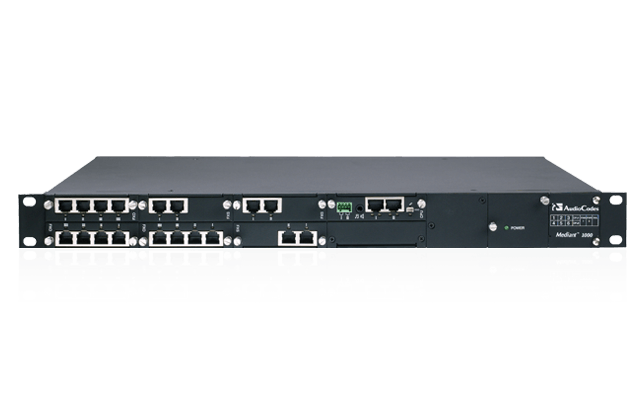
AudioCodes Mediant 1000 is a cost-effective, converged wireline VoIP media gateway. Intelligently packaged in a stackable 1U chassis, it is designed to interface between TDM & IP networks in enterprises or small-scale carrier locations. Incorporating AudioCodes’ innovative Voice over Packet technology, the Mediant 1000 enables rapid time-to-market and reliable cost-effective deployment of next-generation networks.
The Mediant 1000 is based on VoIPerfect, AudioCodes' underlying, best-of-breed, media gateway core technology for all of its products. The Mediant 1000 provides superior voice-technology for connecting legacy telephone and PBX systems to IP networks, as well as seamless connection of the IP-PBX to the PSTN. In addition to operating as a pure media gateway, the Mediant 1000 can also host partner applications and serve as an IP-PBX platform. The Mediant 1000 is fully interoperable with multiple vendor gateways, Softswitches, gatekeepers, proxy servers, IP phones, Session Border Controllers and firewalls.
The Mediant 1000 matches the density requirements for small locations while meeting enterprises' and service providers’ demands for scalability. The compact Mediant 1000 Modular Gateway is extremely scalable and supports multiples of 1, 2, or 4 E1/T1/J1 spans, 4 to 20 BRI ports or 1 to 24 analog ports in various FXO/FXS configurations. The Mediant 1000 also supports mixed digital/analog with media processing capabilities such as conferencing, play/record configurations.
The Mediant 1000 can support a variety of telephony interfaces. The digital module can be configured as regular E1/T1/J1 interfaces, with up to 1 or 2 paired spans acting as life-line interfaces for switching to the PSTN in case of power failure or network problems. The analog module is available as regular FXS or FXO interfaces, where 1 FXS line can be used as a life-line interface for switching to the PSTN.
Customers who connect to centralized IP-Centrex services, as well as branch offices of enterprises that use a centralized IP-PBX server may face a survivability challenge. Stand Alone Survivability (SAS), supported in the Mediant 1000 is based on the SIP B2BUA (Back to Back User Agent) functionality, and enables the backup of SIP clients such as SIP IP and Soft Phones in the case of a connectivity failure with the centralized SIP server.
The Mediant 1000 has enhanced hardware and software capabilities to ease its installation and to help maintain voice quality. If the measured voice quality falls beneath a pre-configured value, or the path to the destination is disconnected, the Mediant 1000 can assure voice connectivity by falling back to the PSTN. In the event of network problems, calls can be routed back to the PSTN without requiring routing modifications in the PBX. Further reliability is provided by dual Ethernet ports and optional dual AC power supply.
The Mediant 1000 extends the flexibility of the Media Gateway family with additional deployment options. The open platform on the Mediant 1000 offers partners the option to host their own applications (e.g., IP-PBX, call center, conferencing and messaging applications) using the OSN (Open Solution Network) Server platform, including a powerful processor and hard disks to
provide a complete solution within the Mediant 1000 chassis along with rich SIP gateway features.
The AudioCodes Mediant 1000 enterprise session border controller (E-SBC) and media gateway is designed to provide a complete connectivity solution for small-to-medium sized enterprise locations.
Scaling up to 150 concurrent sessions, the Mediant 1000 connects IP-PBXs to any SIP trunking service provider and offers superior performance in connecting any SIP to SIP environment.
In addition, it supports up to 192 concurrent voice sessions in a 1U modular platform to enable versatile connectivity between TDM and VoIP networks.
The modular Mediant 1000 connects IP-PBXs to any SIP trunking service provider, scaling to 150 concurrent SBC sessions. It offers superior performance in connecting any SIP to SIP environments, legacy TDM-based PBX systems to IP networks, and IP-PBXs to the PSTN.
AudioCodes Mediant 1000 is a cost-effective, converged wireline VoIP media gateway. Intelligently packaged in a stackable 1U chassis, it is designed to interface between TDM & IP networks in enterprises or small-scale carrier locations. Incorporating AudioCodes’ innovative Voice over Packet technology, the Mediant 1000 enables rapid time-to-market and reliable cost-effective deployment of next-generation networks.
The Mediant 1000 is based on VoIPerfect, AudioCodes' underlying, best-of-breed, media gateway core technology for all of its products. The Mediant 1000 provides superior voice-technology for connecting legacy telephone and PBX systems to IP networks, as well as seamless connection of the IP-PBX to the PSTN. In addition to operating as a pure media gateway, the Mediant 1000 can also host partner applications and serve as an IP-PBX platform. The Mediant 1000 is fully interoperable with multiple vendor gateways, Softswitches, gatekeepers, proxy servers, IP phones, Session Border Controllers and firewalls.
The Mediant 1000 matches the density requirements for small locations while meeting enterprises' and service providers’ demands for scalability. The compact Mediant 1000 Modular Gateway is extremely scalable and supports multiples of 1, 2, or 4 E1/T1/J1 spans, 4 to 20 BRI ports or 1 to 24 analog ports in various FXO/FXS configurations. The Mediant 1000 also supports mixed digital/analog with media processing capabilities such as conferencing, play/record configurations.
The Mediant 1000 can support a variety of telephony interfaces. The digital module can be configured as regular E1/T1/J1 interfaces, with up to 1 or 2 paired spans acting as life-line interfaces for switching to the PSTN in case of power failure or network problems. The analog module is available as regular FXS or FXO interfaces, where 1 FXS line can be used as a life-line interface for switching to the PSTN.
Customers who connect to centralized IP-Centrex services, as well as branch offices of enterprises that use a centralized IP-PBX server may face a survivability challenge. Stand Alone Survivability (SAS), supported in the Mediant 1000 is based on the SIP B2BUA (Back to Back User Agent) functionality, and enables the backup of SIP clients such as SIP IP and Soft Phones in the case of a connectivity failure with the centralized SIP server.
The Mediant 1000 has enhanced hardware and software capabilities to ease its installation and to help maintain voice quality. If the measured voice quality falls beneath a pre-configured value, or the path to the destination is disconnected, the Mediant 1000 can assure voice connectivity by falling back to the PSTN. In the event of network problems, calls can be routed back to the PSTN without requiring routing modifications in the PBX. Further reliability is provided by dual Ethernet ports and optional dual AC power supply.
The Mediant 1000 extends the flexibility of the Media Gateway family with additional deployment options. The open platform on the Mediant 1000 offers partners the option to host their own applications (e.g., IP-PBX, call center, conferencing and messaging applications) using the OSN (Open Solution Network) Server platform, including a powerful processor and hard disks to
provide a complete solution within the Mediant 1000 chassis along with rich SIP gateway features.
The AudioCodes Mediant 1000 enterprise session border controller (E-SBC) and media gateway is designed to provide a complete connectivity solution for small-to-medium sized enterprise locations.
Scaling up to 150 concurrent sessions, the Mediant 1000 connects IP-PBXs to any SIP trunking service provider and offers superior performance in connecting any SIP to SIP environment.
In addition, it supports up to 192 concurrent voice sessions in a 1U modular platform to enable versatile connectivity between TDM and VoIP networks.
The modular Mediant 1000 connects IP-PBXs to any SIP trunking service provider, scaling to 150 concurrent SBC sessions. It offers superior performance in connecting any SIP to SIP environments, legacy TDM-based PBX systems to IP networks, and IP-PBXs to the PSTN.
Fill in the following form in order to get in touch with us about this product.